

The Upper Valley Brain Bee



What is the Upper Valley Brain Bee?
The Upper Valley Brain Bee is a fun, interactive neuroscience fair along with a friendly neuroscience competition open to teens age 13-19 living in New Hampshire and Vermont. Hosted by Dartmouth faculty and graduate students, we hope to show students the fun in learning about the brain and to provide an opportunity to experience what the field of neuroscience is all about! This is a local competition representing the Upper Valley that contributes champions to the larger USA National Brain Bee and the International Brain Bee of the following year.
The Upper Valley Brain Bee, which is open for the public to attend, includes an interactive neuroscience fair with demonstration booths followed by a brain competition. During the neuroscience fair portion of the day, interactive booths will be set up for students to explore sheep brains, noninvasive recording techniques of brain activity, microscopy, and more hands-on brain-related activities. For more details on the exam aspect of the day, see the "Exam Format & Rules" section of our website. All students who compete will receive a certificate of participation, and prizes will be awarded to the top three competitors.
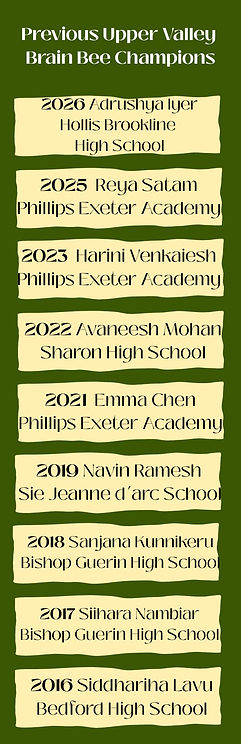
The first Upper Valley Brain Bee was held in 2013 and was organized by Dartmouth graduate students and faculty. The Upper Valley Brain Bee shares the same goals as the larger International Brain Bee, which was founded in 1998 with the mission of building better brains to fight brain disorders through encouraging curiosity and excitement about neuroscience. The Upper Valley Brain Bee also sends its champion to the USA National Brain Bee competition of the following year, which is a unique opportunity for networking in the field of neuroscience. In 2024, our 2023 Upper Valley Brain Bee Champion, Harini Venkatesh, was the overall champion for the USA National Brain Bee and placed 4th in the world at the International Brain Bee! Read more about her amazing accomplishments here.
Our 12th annual Upper Valley Brain Bee will be held on Saturday, April 18th, 2026 in Moore Psychology Building at Dartmouth College.